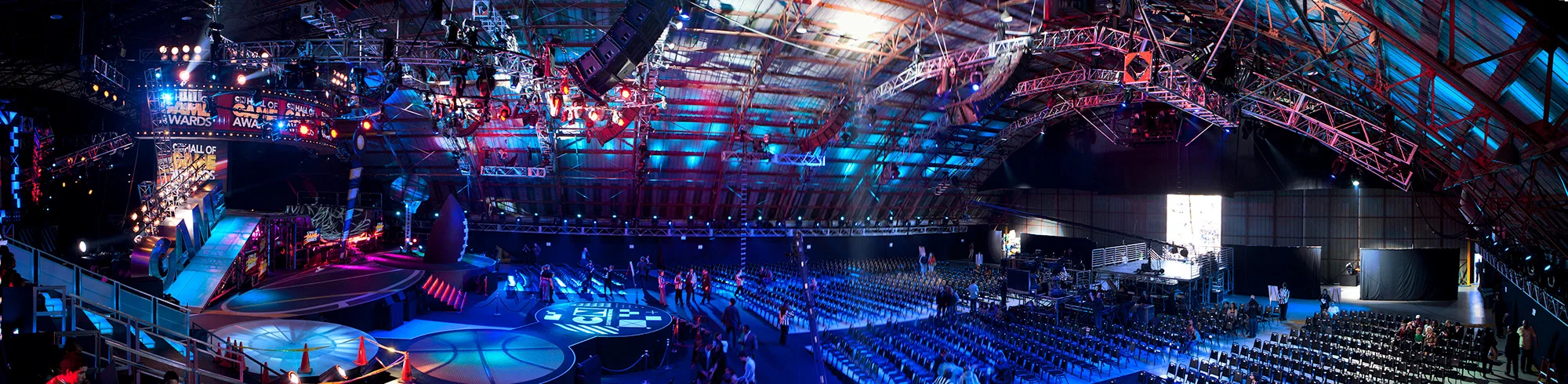
The hangars at Santa Monica Airport are the closest thing this market has to a purpose-built experiential venue: open-plan industrial floors, high ceilings, and clear spans built for aircraft, which happen to suit large-format sets and creative builds better than any hotel ballroom in the city.
That history runs deep in the entertainment industry specifically. Barker Hangar in particular has carried decades of car reveals, award-season parties, and brand activations that needed a blank industrial canvas rather than a decorated function room.
The one fact every program should plan around is the airport's future: the City of Santa Monica and the FAA reached an agreement to end aviation use at the airport by December 31, 2028, and the runway was already shortened in 2017. Event space availability inside that broader timeline is a separate question from the airport's flight operations, but a program planning multiple years out should confirm current terms directly rather than assume nothing has changed.
Execution priorities
- Open-plan industrial hangar spaces with high ceilings, built for experiential and creative builds rather than banquet-style events.
- Sits within Santa Monica city limits, with a long history of major brand activations and entertainment industry events.
- The City of Santa Monica and the FAA have agreed to end aviation use at the airport by December 31, 2028, a timeline separate from event-space bookings but worth confirming for long-lead programs.
- Best suited to product launches, media events, and large-format private gatherings rather than multi-day conferences.
What an airport hangar gives a build that a ballroom does not
Clear spans and high ceilings let a production team build vertically, rig from grid points instead of a ballroom's limited hard points, and treat the floor as a blank industrial canvas rather than a carpeted room with fixed chandeliers and columns.
That openness is exactly why product reveals and large media events gravitate here: a reveal moment, a stage build, and a press pen can all sit inside one uninterrupted floor plate without competing for space with a hotel's standard room configuration.
Access, power, and industrial load-in
Hangar doors built for aircraft translate well to oversized freight, vehicle reveals, and large scenic elements that would not clear a standard loading dock, which is a real advantage for automotive and product launches specifically.
Power and rigging infrastructure on an airport property is not identical to a convention center's, so a production team should confirm available service and any supplemental generator needs early rather than assuming convention-hall-grade infrastructure is already in the building.
Planning inside a changing timeline
The airport's aviation-use agreement with the FAA runs through the end of 2028, and that broader civic timeline is worth tracking for any program planning multiple years ahead, even though event-space bookings and flight operations are managed separately.
For a near-term program, this changes nothing about the booking process; for a multi-year activation calendar or an annual event that wants to return to the same hangar, it is worth a direct conversation with the venue about availability beyond the current lease terms.
Where hangar events fit in a Santa Monica program
A hangar event pairs naturally with press and media logistics elsewhere in the Westside media and entertainment corridor, and with Santa Monica's broader Silicon Beach tech presence, since many product-launch clients already have offices or press contacts nearby.
Programs that need both a launch moment and supporting sessions often anchor the reveal in a hangar and run breakouts, dinners, or executive meetings at a nearby hotel, treating the two venues as one coordinated program rather than separate bookings.
Insurance and liability at an airport property
Airport-adjacent event space typically carries insurance and liability requirements beyond a standard indoor venue, since the hangar sits on active airport property even when the event itself has nothing to do with flight operations.
Confirming those requirements with the hangar operator early, rather than assuming ballroom-standard coverage applies, keeps a launch's insurance paperwork from becoming a last-minute renegotiation days before load-in.
Frequently asked questions
What kind of events fit an airport hangar venue?
Product launches, media events, and large-format private gatherings that benefit from open-plan industrial space and high ceilings.
Is Santa Monica Airport closing?
The City of Santa Monica and the FAA agreed to end aviation use by December 31, 2028; event-space availability should be confirmed directly with the venue for any long-lead program.
Can vehicles or oversized freight move into the hangars?
Hangar doors built for aircraft generally accommodate oversized freight and vehicle reveals that would not clear a standard loading dock.
Is convention-grade power and rigging already installed?
Not by default; confirm available power service and rigging infrastructure with the venue before finalizing a production plan.
Does hangar event space require special insurance?
Typically yes; airport-adjacent event space carries insurance and liability requirements beyond a standard indoor venue, so confirm current requirements directly with the operator.