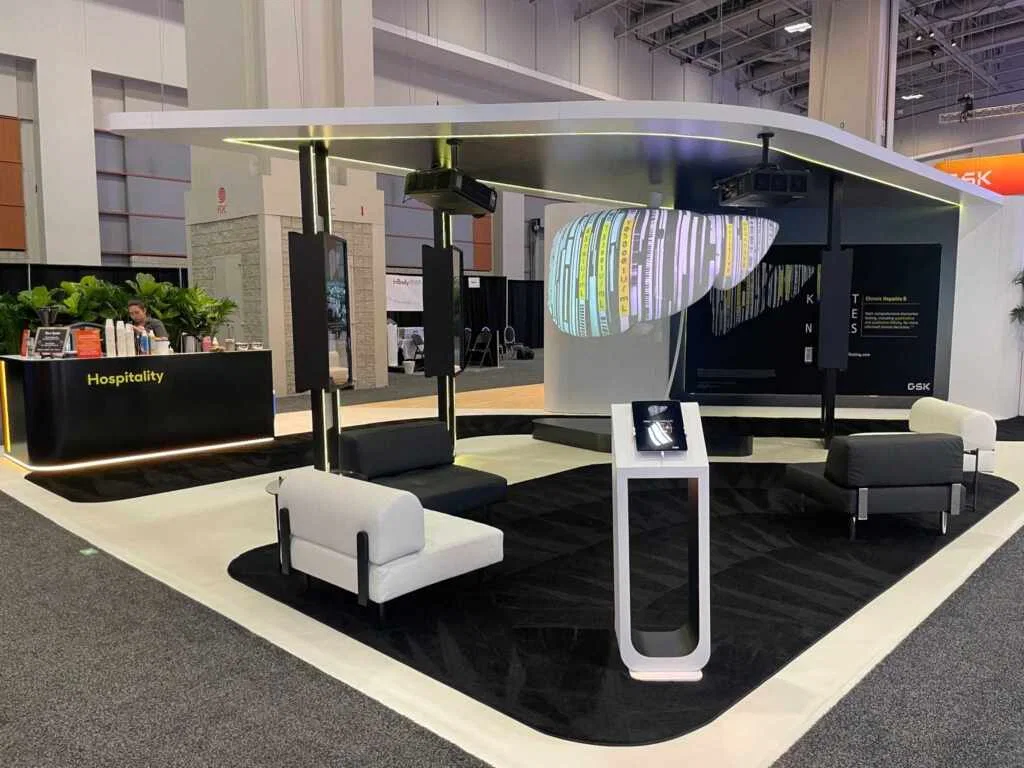
A custom exhibit booth starts from a blank floor plan rather than a set of standard parts, engineered and fabricated for a specific footprint, a specific show, and often a specific message the exhibitor only needs to make once.
That freedom comes at a cost most modular or rental buyers do not carry: engineering time, a longer production schedule, and a structure that may need real work to adapt if the next show has a different footprint.
Execution priorities
- A production timeline measured in months, not weeks.
- Engineering sign-off for anything structural, including a second level or a heavy hanging element.
- A storage and refurbishment plan for the years after the debut show.
- A clear answer for whether the design has to change for a different hall next time.
A booth designed for one show, not every show
Most custom builds exist because a standard modular or rental system could not deliver something the brand needed: an exact material, a shape no catalog part offers, or a layout tied to a specific hall's dimensions.
That specificity is the entire value of going custom, and it is also the reason a custom booth rarely transfers cleanly to a different footprint the way a modular system does.
Engineering the parts a catalog can't sell
Anything structural, a second level, a large hanging sign, or an unusual cantilever, needs engineering drawings stamped for the specific hall before the general contractor will approve it, and that review adds real weeks to the schedule.
Fabrication for a one-off structure also takes longer than assembling standard parts, since nothing is sitting pre-built in a warehouse waiting to ship.
A custom fabricator also has to source materials specific to the design rather than pulling from stocked modular inventory, and lead times on those materials can shift the whole production schedule if they are not confirmed early.
Storage, refurbishment, and the second life
A custom structure has to live somewhere between shows, and unlike a modular kit's cases, a custom build's crates are shaped for that one structure, which limits storage options and adds cost the first time an exhibitor budgets for it.
Refurbishment between shows, graphics changes, touch-up finishes, replacing worn panels, keeps a custom booth looking new longer than skipping maintenance and hoping the next show goes well.
Some exhibitors budget refurbishment as a fixed line item every year the structure is in use, which spreads the cost predictably instead of facing one large repair bill right before a flagship show.
Budget lines a custom build actually touches
Design and engineering fees show up before a single panel is cut, which surprises exhibitors used to a modular or rental quote where those costs are already absorbed into the catalog price.
Freight for a custom structure also tends to run heavier than a comparable modular kit, since bespoke materials rarely optimize for case weight the way a purpose-built modular system does.
Insurance for a one-of-a-kind structure is worth a separate conversation too, since replacing a damaged custom piece is rarely as simple as ordering a spare part from a modular catalog, and quotes on that coverage should be gathered before the final budget is locked.
Frequently asked questions
How far ahead does a custom booth need to start?
Design, engineering approval, and fabrication together typically run several months, so a custom build for a show date needs to start well before a modular or rental order would.
Does a custom booth need a different engineering review for every hall?
Any structural element, a second level or a large hanging sign in particular, needs its own review against the specific hall's rigging grid and load limits, even if the booth design itself does not change.
Can a custom booth be reused at a different show next year?
Sometimes, if the next hall's footprint and rigging match closely enough, but a custom structure adapts less easily than a modular kit, and reuse often means a real redesign rather than a simple reconfiguration.
Where should a custom structure be stored between shows?
Most exhibitors store with the exhibit house that built it, since the crates are shaped for that specific structure and general storage space rarely accommodates bespoke fabrication well.
Is a custom booth worth it for a company doing several shows a year?
It depends on whether one show matters enough to justify a structure built for it specifically; most multi-show exhibitors pair a custom flagship build for their biggest event with a modular kit for the rest of the calendar.